




MX-5 Bushes: Poly or Rubber?
Ask any MX-5 owner what makes their car special and you’ll hear the same things: the balance, the feedback, the connection between driver and road. That connection doesn’t just come from the engine and gearbox, it runs through every bush in the suspension.
Yet bushes are one of the most overlooked components on the MX-5. Quietly doing their job until they don’t, worn or degraded bushings can subtly rob the car of the very qualities that make it so enjoyable. And when it’s time to replace them, many owners face a choice they hadn’t considered before: standard rubber or polyurethane?
In this guide, we’ll break down exactly what bushings do, how rubber and poly compare, what you’ll notice in real-world driving, and which option makes sense for your MX-5.
What Do Suspension Bushes Actually Do?
Suspension bushes are the small cylindrical or spherical rubber (or polyurethane) inserts pressed into your suspension arms, anti-roll bar mounts, and subframes. Their job is to allow controlled movement while isolating the chassis from noise, vibration, and harshness, commonly abbreviated as NVH.
They’re essentially the interface between your car’s suspension geometry and its body. When they’re in good shape, they keep everything aligned as designed, help the suspension move predictably, and absorb unwanted vibrations before they reach the cabin. When they wear out, things get vague, noisy, and imprecise.
On a car like the MX-5, where handling precision is fundamental to the whole experience, even moderate bush wear can have a disproportionate effect on how the car feels.
Signs Your MX-5 Bushes Need Attention
Because wear is gradual, it’s easy to adapt to without noticing. Common symptoms include:
• Imprecise or vague steering, particularly on turn-in
• Understeer or oversteer that wasn’t there before
• Clunking or knocking over bumps and potholes
• Excessive body roll in corners
• Uneven or accelerated tyre wear
• Vibration or road noise that’s crept into the cabin
If your MX-5 doesn’t feel as taut and responsive as it once did, ageing bushes are a very likely cause — especially on cars with more than 60,000 miles.
Rubber vs Polyurethane: What’s the Difference?
This is where personal preference, driving style, and how you use your car all come into play.
Standard Rubber Bushes
The original equipment choice on all MX-5s from Mk1 to Mk4. Rubber does an excellent job of absorbing vibration and providing a smooth, compliant ride. It’s quiet, progressive, and works well with the MX-5’s road-going remit.
The downside is longevity. Rubber is susceptible to degradation from UV exposure, ozone, road grime, and heat cycling, all common in UK conditions. Over time it softens, cracks, and tears. This is why standard bushes on older MX-5s often look fine externally but have lost their ability to control suspension movement properly.
If you’re restoring a car to original specification, or you prioritise a compliant, quiet ride above all else, quality replacement rubber bushes are a solid choice.
Polyurethane (Poly) Bushes
Polyurethane is a synthetic material that’s significantly more resistant to the elements than rubber. It doesn’t degrade in the same way and maintains its properties far longer, which is why it’s the preferred choice for many MX-5 owners who want long-term performance.
The key advantages of poly:
• Greater durability — lasts considerably longer than rubber
• More consistent suspension geometry over time
• Better handling response and sharper turn-in
• Improved steering feel and feedback
• Reduced flex under hard cornering
The long-standing criticism of polyurethane has been increased NVH — more noise, vibration, and harshness transmitted into the cabin. On older, harder formulations this was a legitimate concern. However, modern polyurethane products have addressed this significantly.
Why Modern Poly Bushes Are a Different Proposition
Polybush, one of the leading names in suspension bushings for road cars, has developed their products specifically around the fast road use case. The result is a material that delivers meaningfully better handling without the harshness penalties associated with older polyurethane products.
For MX-5 owners, this matters enormously. The car is designed to be an everyday sports car — enjoyable on your morning commute as well as a Sunday B-road blast. A bushing upgrade that compromises ride quality would undermine that. With Polybush products, the feedback from owners consistently confirms that ride quality remains excellent, with the handling benefits of a more controlled suspension.
A Critical Issue on Mk4 MX-5s: Rear Hub Bearing Failure
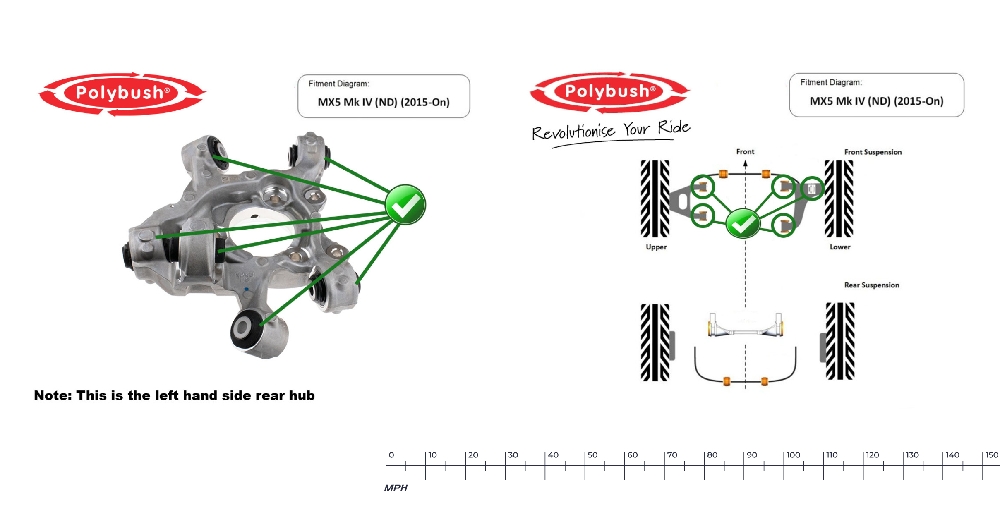
Mk4 owners need to pay particular attention to one specific bush location: the rear hub upper and lower lateral arm bushes. This is not a routine wear issue, it’s a known problem with the original components.
The standard rear hub bushes on Mk4 and RF models use spherical bearings rather than a conventional suspension bush design. These have been widely reported to suffer premature failure — and the consequences are significant. When they fail, the rear suspension geometry is compromised, affecting handling and tyre wear.
The problem: The original bushes are not available separately so until recently, the only official solution was to replace the entire rear hub assembly at approximately £650 per side, plus labour. And the replacement hub comes fitted with the same original-spec spherical bearings, making it only a matter of time before the problem returns.
The solution: Polybush has developed a purpose-designed replacement kit that eliminates the problematic spherical bearings entirely.
The Polybush Rear Hub Upper & Lower Lateral Arm Bushes for MX-5 Mk4 & RF is supplied as a set of four, enough for both sides of the car, and fits all Mk4 and RF models from 2015 onwards.
Key benefits of this kit:
• Eliminates the known failure point entirely, replacing spherical bearings with a far more durable polyurethane design
• Extensively tested by Paul Roddison Racing, ensuring real-world performance and durability have been validated
• Considerably more cost-effective than hub replacement
• Takes no more effort to fit than standard bushes
• Improves handling, steering response, road holding, and stability over the original specification
• Maintains excellent ride quality — no compromise in everyday comfort
• Lasts significantly longer than standard bushes, making it a long-term solution
It’s worth noting that this kit is specifically designed in blue to replace the original spherical-bearing bushes, and cannot be substituted for the orange Polybush version. If your Mk4 is approaching or beyond 40,000 miles or you are experiencing the tell-tale knock from the rear suspension, this is one of the most worthwhile investments you can make.
Generation-by-Generation: What to Look For
Mk1 (NA, 1989–1998)
The original MX-5 is now well into classic car territory, and original rubber bushes have had three-plus decades to degrade. Handling vagueness, clunking suspension, and uneven tyre wear are all common on Mk1s running tired original bushings. A full bushing refresh is one of the best things you can do to revive an older NA.
Browse Mk1 suspension bushes
Mk2 / Mk2.5 (NB, 1998–2005)
The NB shares much of its suspension architecture with the Mk1 and suffers similar bushing wear patterns. Anti-roll bar bushes and lower arm bushes tend to be the first to show age. Many Mk2 owners find that a bushing refresh transforms the car’s composure and precision.
Browse Mk2 suspension bushes
Mk3 / Mk3.5 / Mk3.75 (NC, 2005–2015)
The NC is a heavier, more refined car, and its bushing wear tends to manifest as handling that feels blunter than expected rather than obvious clunking. Anti-roll bar bushings and rear subframe bushes are common wear points. Upgrading to poly on an NC can make it feel considerably sharper without upsetting its more GT-oriented balance.
Browse Mk3 suspension bushes
Mk4 / ND & RF (2015–Present)
The ND is arguably the finest MX-5 yet made, and its suspension geometry is beautifully judged. Keeping that geometry intact as the car ages is important, which is why bushing condition matters. Beyond routine wear, Mk4 owners should be particularly aware of the rear hub lateral arm bushing issue outlined above.
Browse Mk4 suspension bushes
Which Should You Choose?
For most UK MX-5 owners, the answer comes down to priorities:
• Choose quality rubber replacements if you want to restore original ride quality and NVH levels on a car used primarily as a comfortable daily driver or at shows.
• Choose polyurethane if you want longer-lasting performance, sharper handling response, and are happy with the modest trade-offs in isolation, which on modern Polybush products are minimal.
• Choose the Polybush rear hub kit if you own a Mk4 or RF, this isn’t just about performance, it’s about preventing a known and costly failure.
It’s also worth considering a mixed approach: polybushes at high-stress points (anti-roll bars, rear arms) combined with quality rubber at the front where NVH absorption is more critical to comfort. Many experienced MX-5 builders do exactly this.
Small Parts, Big Rewards
Suspension bushes might be one of the less glamorous areas of MX-5 ownership, but they’re fundamental to everything the car does well. Keeping them in good condition, or upgrading strategically, is one of the highest-value improvements you can make.
Whether you’re reviving a well-loved Mk1, sharpening up a Mk3, or protecting a modern ND from a known failure, the right bushes can transform how your car feels and how long it stays that way.
Shop suspension bushes for your MX-5:
- Mk1:
- Mk2:
- Mk3:
- Mk4:
- Featured Product - Mk4 / RF rear hub bushing kit:
Leave your comment