




The Mazda MX-5 is rightly celebrated for its balance, a car where the brakes, engine, chassis, and steering all feel like they're working together rather than fighting each other. Part of that harmony comes from a braking system that, when working properly, is progressive, communicative, and well-suited to the car's lightweight nature.
But when a caliper starts to stick, that harmony unravels quickly. A dragging brake doesn't just feel wrong, it generates heat, destroys pads and discs prematurely, affects handling balance, and in more serious cases can become a safety issue. The good news is that sticky calipers are a well-understood problem, and on an MX-5 they're entirely fixable once you know what you're dealing with.
Here's a straightforward guide to spotting the signs, diagnosing the cause, and deciding whether your calipers need a clean, a rebuild, or a replacement.
How a Brake caliper Works
Before diagnosing a problem, it helps to understand what's happening when everything works correctly. When you press the brake pedal, hydraulic pressure pushes the caliper piston outward, clamping the brake pads against the disc. Release the pedal and the piston retracts, slightly, thanks to the elasticity of the rubber piston seal, allowing the disc to spin freely again.
The caliper body is mounted on guide pins (also called slider pins) that allow it to float inward and outward as the pads wear, ensuring even pressure across both the inner and outer pad. On the rear of most MX-5s, the caliper also incorporates a mechanical handbrake mechanism that operates a secondary system within the same unit, a complication that creates additional potential failure points.
Anything that interrupts this cycle of application and release is what we broadly call a sticky caliper.
Symptoms to Watch For
Sticky calipers can range from a minor, insidious drag to a full seizure. Here's what to look out for:
The car pulls to one side under braking. If the braking force is uneven between the two front (or rear) calipers, the car will pull toward the side with more braking force, typically the side where the caliper is sticking and applying more pressure than it releases.
A dragging sensation or resistance when rolling. A partially stuck caliper means the pads never fully release from the disc. You may notice the car feels like it's working against itself, particularly when accelerating from low speed.
Excessive heat from one wheel. After a run, a wheel that's noticeably hotter than its counterpart on the other side, or has an unusual smell, is a classic sign of a caliper that hasn't fully released. In severe cases, you may see brake dust discolouration or even heat distortion on the wheel itself.
Uneven or accelerated pad and disc wear. If one brake pad is wearing significantly faster than its opposite, or if a disc is showing deep scoring on one side only, a sticky caliper is a likely culprit.
A seized or ineffective handbrake. On the rear calipers, especially, the mechanical handbrake mechanism can corrode or seize independently of the hydraulic piston, leaving you with a handbrake that holds weakly, doesn't release cleanly, or causes the rear to drag on one side.
Spongy or inconsistent brake pedal feel. If a caliper is sticking badly enough to cause uneven pad wear or heat buildup, the resulting disc warping or pad glazing can feed back into the pedal feel — making it harder to identify brake feel as reliable feedback.
What Causes calipers to Stick?
Seized guide pins (slider pins). This is probably the most common cause of a sticking caliper on a UK-road MX-5. The guide pins are housed in rubber boots that keep out moisture and contaminants. Over time — particularly in a UK climate where road salt, standing water, and cold-temperature cycling are routine — the boots perish, moisture ingresses, and the pins corrode inside their bores. A corroded guide pin can no longer slide freely, so the caliper can't move as the pads wear, leading to uneven contact and a brake that doesn't release cleanly.
Corroded or swollen caliper pistons. The pistons live in a hydraulic environment and are protected by a dust seal and the piston seal itself. If either seal degrades, moisture finds its way in. Corrosion on the piston surface prevents it from retracting smoothly after braking, leaving the pads in partial contact with the disc.
Degraded piston seals. Even without visible corrosion, old or perished piston seals lose their ability to retract the piston properly when brake pressure is released. This is a subtler form of sticking — the piston doesn't fully seize, but it doesn't fully retract either.
Old brake fluid. Brake fluid is hygroscopic — it absorbs moisture from the atmosphere over time. Contaminated fluid degrades internal seals faster and lowers the boiling point of the system. Flushing brake fluid every two years is a simple preventive measure that many owners overlook.
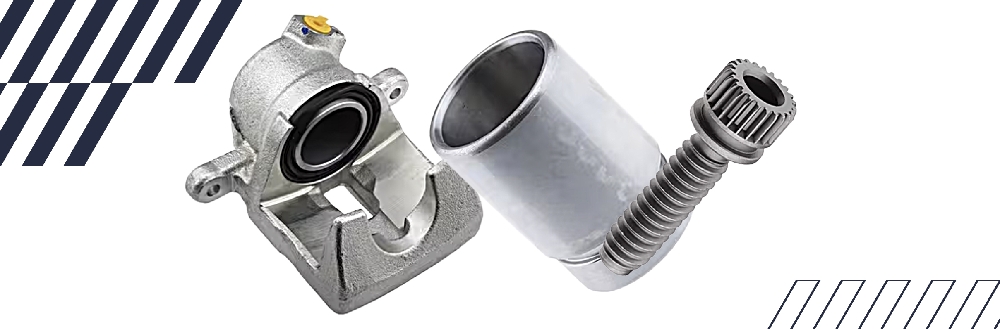
Seized rear handbrake mechanism. The rear calipers on the MX-5 use a threaded adjuster mechanism to apply the handbrake mechanically, separate from the hydraulic circuit. This mechanism is particularly vulnerable to corrosion on cars that see regular wet-weather use or have sat unused for extended periods. A seized adjuster can leave the rear brakes partially applied even when the handbrake is released, or cause a pulling sensation when the handbrake is applied.
Corroded / Dirty caliper Carrier. Another common cause of sticky brakes is excessive dirt or corrosion in the caliper carrier. This is the metal bracket bolted to the hub that the brake pads sit in and the caliper itself then fixes to. Whilst most of the work is done by the caliper, if the pads are stuck in the carrier and don’t fully release from the disc, this will also cause the brakes to bind on. The fix for this is simple. Just remove the pads, clean up the carrier with a wire brush and then apply some high-temperature grease to the slots where the pads fit in. In cases of extreme corrosion or physical damage then your only option is to replace the carrier bracket which are available separately from the caliper.
Clean, Rebuild, or Replace?
The right course of action depends on how far the problem has progressed.
Clean and lubricate if the guide pins are corroded but the bores are intact, the piston moves freely by hand, and the seals are in reasonable condition. Removing, cleaning, and re-greasing the guide pins with the correct high-temperature brake grease is a straightforward job that can resolve a sticking caliper entirely if caught early. Replacing the guide pin boots at the same time is cheap insurance.
Rebuild if the piston seals are degraded or the piston has surface corrosion that's affecting movement. caliper rebuild kits, which typically include new piston seals, dust boots, and guide pin boots, allow you to restore the caliper to proper working order without the cost of a full replacement. This is the right call for a caliper that's structurally sound but has failed internally. Clean everything thoroughly, inspect the piston bore for scoring, and use fresh brake grease and the correct silicone-based assembly fluid on the seals.
Replace if the caliper body is cracked, the piston bore is scored or badly corroded, or the caliper has been overheated to the point of internal seal damage that a rebuild kit won't address. Similarly, if the rear handbrake adjuster mechanism has seized completely within the caliper, replacement is often more practical than attempting to free a mechanism that's corroded solid.
On an older Mk1, Mk2, or Mk3 MX-5, replacement calipers are generally good value and fitting a remanufactured unit gives you the confidence of a fully rebuilt assembly with fresh seals throughout. For a Mk4 ND, rebuilding with a quality kit is usually the first port of call.
A Few Preventive Notes
Brake calipers require maintenance. Checking the condition of your guide pin boots during each brake pad change costs nothing and can prevent a full seizure from developing. Flushing brake fluid on schedule matters more than most people realise. And if your MX-5 is stored for extended periods, releasing the handbrake during storage is good practice to prevent the rear mechanism from corroding in the applied position.
A sticky caliper rarely appears without warning; the symptoms are usually there if you know what to look for. Catching the problem early means a clean and a new set of boots rather than a full replacement, and it means your MX-5 keeps doing what it does best: stopping as well as it goes.
Featured Products
- Caliper Seal Kits
- Rear Caliper Piston (MK1 & Mk2)
- Rear Caliper Adjuster Screw (Mk1 & 2)
- Slider Pin Kit (Mk1 & 2)
- Aftermarket Front Caliper (Mk3)
- Genuine Rear caliper (Mk4)
Leave your comment