




There are few things more frustrating than an MX-5 that doesn't feel right. Not broken, not undriveable, just rough. A stumble under acceleration, a lumpy idle, a hesitation that wasn't there last week. More often than not, what you're experiencing is a misfire, and while the causes vary, the good news is that the most common ones are straightforward to diagnose and fix.
An MX-5 misfire can range from a barely perceptible irregularity at idle to a full-on shudder that sets off the engine warning light and drops the car into limp mode. Either way, it's worth tracking down properly rather than guessing, because throwing parts at a misfire without a plan costs money and doesn't always fix the problem.
This guide covers the main culprits: spark plugs, ignition leads, coil packs, and fuel delivery. We'll look at how each one fails, what that feels like from the driver's seat, and how to work through them systematically.
What Is a Misfire, Exactly?
A misfire occurs when a cylinder fails to fire correctly, or doesn't fire at all. The engine management system in modern MX-5s monitors crankshaft speed for tiny irregularities that indicate a cylinder isn't contributing its share of power. When it detects a pattern, it logs a fault code and on many cars will illuminate the engine management light.
The sensation depends on which cylinder is misfiring and how severely. A single cylinder firing poorly gives the engine a loping, uneven feel. A cylinder that's completely dead produces a more obvious rough running, often with a noticeable vibration through the gear lever and seat.
Causes broadly fall into three categories: ignition (the spark isn't reaching the plug or isn't strong enough), fuel (the correct amount of fuel isn't being delivered or atomised), and mechanical (compression issues, a longer conversation for another day). The vast majority of MX-5 misfires are ignition or fuel related.
Spark Plugs: Start Here
Spark plugs are the first thing to check on any MX-5 misfire and, more importantly, the first thing to rule out. They're inexpensive, accessible, and they tell you a great deal about what's happening in the combustion chamber.
Mazda specifies plug change intervals, but real-world conditions, short journeys, extended idling, running slightly rich, can foul plugs well before the recommended mileage. On a Mk1 or Mk2, plugs are easy to access and worth inspecting at any sign of rough running. On an NC, the coil-on-plug setup means the coils must be removed first, but the job is still well within DIY territory.
When you pull the plugs, look at the electrode and insulator carefully. A healthy plug has a light tan or grey deposit on the insulator. Black, sooty deposits indicate a rich mixture or oil burning. White or blistered-looking insulator suggests the engine is running lean or the plug is the wrong heat range. A plug that's wet with fuel has almost certainly had a misfire, the cylinder isn't firing, so unburnt fuel is washing the electrode.
Always replace plugs in sets. Fitting one new plug into an engine with four worn ones creates an imbalance and doesn't give you a clean baseline to work from. Use the correct plug specification for your model and year, the heat range matters, and fitting an incorrect plug will cause problems of its own. NC MX-5 spark plugs in particular should match Mazda's specification closely, as the NC's engine is more sensitive to plug condition than older engines.
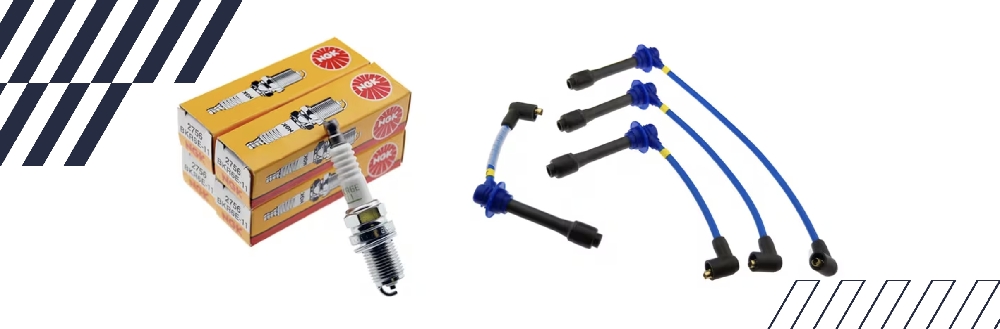
Ignition Leads: The Mk1 and Mk2 Weak Spot
If your MX-5 is a Mk1 (NA) or early Mk2 (NB), it uses high-tension ignition leads, the rubber-jacketed cables that carry the spark signal from the coil to each plug. These leads are a surprisingly common cause of misfires on older cars, and they often get overlooked because they look fine externally even when they're failing internally.
MX-5 ignition leads degrade with age and heat cycling. The insulation cracks, the internal conductor corrodes or breaks down, and resistance increases to the point where the spark arriving at the plug is too weak to ignite the mixture reliably. In damp conditions, worn leads will also arc to earth across the cracked insulation rather than firing the plug, which is why many older MX-5 misfires are worse first thing in the morning or in rainy weather.
Testing leads with a multi-meter gives you resistance values to compare against specification, but a visual inspection of the boots and jacket while the engine is running in low light can also reveal arcing. A quality set of replacement leads is a worthwhile investment on any NA or NB with significant mileage, and the improvement in throttle response and idle quality on a tired set can be immediately obvious.
Coil Packs: The Ignition Systems Achilles Heel
Mk1 & Mk2 models all have a separate coil pack at the back of the engine bay which as mentioned above delivers the spark to the plug via HT leads. These coils are susceptible to degrading slowly because of extreme engine heat, constant vibration, and high electrical stress. Over time, these forces break down the internal copper wire insulation, causing short circuits or weak sparks, and eventually, complete failure. From the NC onwards, the MX-5 dispensed with a separate coil and ignition leads in favour of coil-on-plug ignition (with the notable exception of the Mk2.5 VVTI which has both!), one individual coil pack per cylinder, sitting directly on top of each spark plug. It's a cleaner, more efficient system, but the MX-5 NC coil pack is a known weak point.
NC owners experiencing a misfire should pay close attention to whether the fault is consistent or intermittent, and whether it's worse when the engine is hot or cold. Failing coil packs often produce a misfire that clears when the engine warms up, or conversely a misfire that only appears once the coil has been working for a while and heat has caused a breakdown in the internal winding.
Fault codes from the engine management system will typically point to a specific cylinder, P0301 through P0304 indicate misfires on cylinders one through four respectively. If you have code reader access, this is enormously helpful for narrowing down which coil to test. You can also swap coils between cylinders to see if the fault moves with the coil — a simple and cost-effective way to confirm a diagnosis before buying parts.
Fuel System Checks
If the ignition system checks out, fuel delivery is the next area to investigate. MX-5 fuel injectors can become partially blocked over time, particularly on cars that have sat unused or been run on poor-quality fuel. A blocked injector delivers less fuel than the ECU expects, which leans out that cylinder and produces a misfire under load.
Fuel injector cleaner added to the tank is a reasonable first step on a car with no history of injector issues. For a more thorough clean, injectors can be removed and ultrasonically cleaned, which restores flow rates more reliably than a tank additive alone.
Fuel pressure is also worth checking if injector cleaning doesn't resolve the issue. A weak fuel pump will produce pressure that drops under load, starving all cylinders rather than one, which typically produces a flat spot or hesitation rather than a single-cylinder misfire, but can still feel similar to the driver. A fuel pressure gauge test will confirm whether the pump is delivering adequate pressure at idle and under load.
Working Through It Methodically
The temptation with a misfire is to replace the most likely part and hope for the best. A better approach is to work through the ignition system first, plugs, then leads on Mk1/Mk2, then coil packs on NC and ND, before moving to fuel. Each step costs progressively more in parts and labour, so ruling out the inexpensive causes first makes financial as well as logical sense.
An MX-5 that idles cleanly, pulls strongly, and revs freely is a car at its best. Most misfires have a clear cause once you know where to look, and once resolved, the difference in how the car feels is immediate.
Handy Product Links
Mk1 (NA) Products
Mk2 (NB) Products
- All Mk2 Ignition Range
- Mk2/2.5 Standard Spark Plugs
- Mk2.5 VVTI Coils, leads & plugs kit
- Mk2.5 VVTI Magnecor Leads
- Mk2 Magnecor Leads
Leave your comment